With the railway from east Kenya to west Kenya

Reiseberichte Viktoriasee, Viktoriasee, Mombasa Reiseberichte, Reiseberichte Kenia, Kenia Reiseberichte, Kenia, Kisumu, Nairobi, Malindi,

Mit dem Zug von Mombasa nach Nairobi. Mit dem Zug von Mombasa nach Kisumu am Viktoriasee


.

With the course from Mombasa to Kisumu at the LakeViktoria

.

Report on a journey Kenya

With Kenya Railways

Timetable Kenya Railways . Prices of transportation Kenya Railways

On the traces of Hans Schomburgk we wanted to change in our six weeks Kenya - vacation. We had booked a package tour with Neckermann. Three weeks in Malindi on the north coast and three weeks Diani Beach at the south coast.

.

Already in Germany we had sat down it into the head to travel with the railway of Mombasa straight through Kenya after Kisumu at the Viktoriasee. A small Safaribüro in Malindi worried about the procurement of tickets for the trip with the railway. The transport from Malindi to Mombasa and back, still belonged to the achievements of the Safaribüros. Our luggage consisted of a small traveling bag, a video camera and a language leader. For my report on a journey I could digitize the film for a few pictures. The language leader was absolutely necessary for lack of English knowledge and its necessity increased the attraction of the journey substantially. The trip from Malindi to the station into Mombasa took place in a small Safaribus. With us still another married couple with an adult son drove. They were experienced Kenya travelers, the Kilimandscharo on a previous journey had already mounted and wanted this time after Nairobi. We had booked sleeping car compartments of the first class. While in the first class roomy compartments for two persons and sleeping cars as well as food cars are offered, there are in the second class compartments with four to six persons. In the third class one sits on wood banks.

.

.

The compartments were clearly excellent. Our travel acquaintance did not exchange with us a compartment that like our compartment, a connection to the second compartment them belonged, had. Thus the confusion was shortly thereafter perfect. The cause approached in the person of a Kenianers, whose name stood on a sign and which stressed so with good reason a place. Our travel acquaintance placed itself deaf and we was completely overtaxed with our language leader. A Schaffner which we called for, gave themselves very much trouble around clarity to create. Finally it turned out that our travel acquaintance wanted to divide a cab with an African in no case. They rather drängelten themselves to third into a Zweibettkabiene. A last view of the station happening and then came the inspection of the compartment. It was practical to reach clean and the upper bed also easily. Recently we became acquainted Swiss night train, which exhibited exactly the opposite. Punctually the course drove off in the evening. Unfortunately there were to film only night trains, so that one does not see anything, geschweige could.

.

.

Against twenty o'clock we went to the meal. The food car, which is still from the late colonial age, has already something special actually. There was already well-known persons, a young Touristin and an Englishwoman living in Kenya, many Kenianer those except that fed there. We experienced from the Englishwoman, who was years old perhaps fifty that she spent her whole life in Mombasa and them drive first times in the life to Nairobi. We think so much we had understood. The meal was apparently enjoyable, but the washing-up which we got to still see, let to us to become nevertheless somewhat thoughtful. Silver cutlery, from which we had read, it gave at our travel time still. Recently I read in another report that these were replaced by other cutleries. In the meantime the beds were referred. Do not ship the laundry in Mombasa took place in unattractive bags, they permitted however drawn up an objection. The night coolness and the Ruckeln of the course provided for a jerky sleep.

.

.

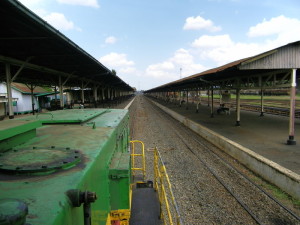
We were early the legs and saw arduous into the night. We filmed the course from a car, which had a middle position. Now and then the course and one held could a driving on the platforms see. The stations in Kenya are all together maintained. For breakfast all guests of the previous evening appeared themselves again in the food car. After the breakfast we approached to Nairobi and in their close environment gave it whole Zebraherden to see. The distance from Mombasa to Nairobi leads across still very urwüchsiges country. A quarter alone by the Tsavogebiet. The settlements which we filmed here are no longer very far from the capital Nairobi.

.

.

The course brought in the morning punctually into the station of Nairobi, which was also last stop. We had course-sewn our trouser pockets with the money, after information about the security situation, from fear of pickpockets. The station free area was full humans, buses, taxis and Matatus. Those had to fight off we, at the same time however a favorable hotel to inquire. Us recommended address in the emperors Haile Selassi Ave, was a fluke. The hotel was only one cat leap from the station distant and one had a good view of the station environment.

.

.

Here quartierten ourselves we for the day. A full bath made, after the arduous night, from us again enterprising humans. We collected in the Moi Avenue a few children, who lay there on the road, in order them a simple breakfast to spendieren. With a Nairobibesuch in the year 2005 it gave to see importantly fewer road children in the city center. Afterwards we made ourselves on the search for a bus, which in Nairobi an adventure for itself is, which brought us to the national park of Nairobi. Estimated prices of the cab drivers before the national park for an inspection appeared to us inadequately, so that we drove again back to Nairobi.

.

.

We took our noon in the Hilton. A waiter there could understand our Suaheli learned up to then completely well, much better still, we could him understand. In the afternoon, at the coffee time, we visited the several times converted still new Stanley hotel originating from the explosive growth from Nairobi, with its famous Thorn Tree Cafe´. In the Thorn Tree Cafe´ is a tree to travelers its messages left can. Afterwards we admired the Christmas decorations of the business and studied the Kenyan viewers. It was a well-known for us and nevertheless different world, us affected.

.

.

Against evening, before it continued to go, we reserved ourselves for the stay on the return journey a room. This day was in Kenya a large national holiday and we wanted to go surely that we get again such a beautiful room, in this so inexpensive hotel. On the station of Nairobi the same picture, as on the day before with the departure, was offered the station from Mombasa. The compartment was again more worn out from the same design, only somewhat.

.

.

We drove into the night, nothing-suspecting like well we it had. A bell of the Schaffner rang the opening of the Speisesaals. But which was that! The cab door let itself toilsome open. The courses were in such a manner occupied with travelers, so that one could set at all no leg for running between them. Humans looked very exotic and many of them had except the luggage, Speere with itself. Once begun to run, we had to fight now for each foot. None made voluntarily also only a few place and we had large fear with the Geschaukel of the course someone to injure. At the food car arrived, our doubts disappeared completely over it whether we should go at all to the meal. The food car was like the courses, just as fully with humans also on earth sat. Now came, and we think that it a daily ceremony on the distance are, with rifles armed soldiers those the food cars empty vacated. We felt terrible, when we sat alone there now only times and were observed by the windows. The food car however still filled with Kenianern, which had perhaps already their experiences and therefore came many later. The distance from Nairobi to Kisumu leads across closely populated country with many cities. It is of Kenya high land region where forty per cent of the Kenianer lives, much industry is settled and in the intensive agriculture is operated. Up to three thousand meters height ascended the trip. In this height it is sensitively cold at the equator, with which we were nearly in direct neighbourhood. The sleep was corresponding. In the morning hours we saw to the windows. Many humans in the courses had already left the course at the numerous stops on the distance, so that we could see from the course, also in the other direction. We took in the food car only tea to us, in order to enjoy in time the sight of the Lake Viktoria, as the entry in Kisumu, had we nevertheless which created, that we ourselves can do, now we it betrayed, in Germany had not correctly believed.

.

.

On the free area we inquired about the Sunset hotel which one us in the Safaribüro had been recommended. It to find was not to foot a problem. In the hotel almost exclusively African stayed overnight. It was inferior to the large hotels in the coast in nothing. The time was scarcely and in such a way explored we in the hotel immediately as we to the equator comes. Completely as near as we it us presented, ran this line not. We had to look for each other in the place a taxi and about the possible costs in the hotel had already informed. The cab driver called equal the correct price and we had in a beautiful landscape, a beautiful trip.

.

.

The transition from the hemisphere to the other one is here, the most beautiful one of all other transitions to Kenya. There is here a small museum. Dealer with souvenirs, which arise as for example in Nanyuki in crowds, does not give it there. That suggests probably that there are nearly no tourists here.

.

.

Arrived in the hotel again we ate Tillapia with Pommfritts in society with apes, which were not importunate. In the point, there were apes nevertheless a difference to the hotels at the coast. After the meal we made an excursion in the environment of the hotel.

.

.

Close by was a small zoo. That guarded of a game guardian with a rifle, which had a bent run. There were not many animals to see. A leopard shifted us an enormous fright. Its cage consisted of a metal frame and thin wire mesh. The game guardian provoked the leopard with his gun and this jumped against the wire mesh, at which we stood closely to. Impalas, a Gazellenart ran around freely, even into the adjoining properties. Subsequently, we looked around still another little Kisumu.

.

.

Afterwards we enjoyed the sunset over the Lake Viktoria from the balcony of the hotel. In the evening we ate again in the hotel. The next day began to drive with the desire on the Lake Viktoria outside. Therefore we pulled to the breakfast also right after toward Viktoriasee. We thought thereby of a small, perhaps the outrigger canoes at the coast resembling sailing boat and contacted a native. That brought us to a completely exclusive yacht club. We could rent a large yacht, for large money, for two hours, with which we undertook a round trip in the bay of Kisumu. In the whole bay by Kisumu traces of oil on the water were to be seen. On the bank we had seen a place out-described as autowash zone, in which active enterprise prevailed.

..

.

Fifty meters a procession with thirty persons for a baptism in the lake continued to take place. The first goal of our boat route was a refinery and a ship landing place, which we regarded obligation-consciously. Afterwards we drove off the bay of Kisumu and landed in a place named Hippo POINT. There many Nilpferde were to be seen. Our ship was so large that we could regard the Kolosse from next proximity. At noon we ate in the hotel and took a bath in the pool of the hotel. In the afternoon we regarded the mansion quarter of Kisumu. In the time up to the departure remained still remaining, took we parting from the Lake Viktoria.

..

.

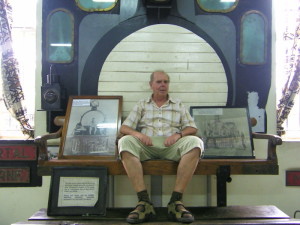
The course became no longer as full on the return trip as on the Hinfahrt. Here we want to tell two stories from the beginnings of the course, which remained for us from Hans Schomburgks narrations in memory. An Indian employee of the line sends a telegram in those days of hundreds kilometers far after Mombasa: Assistance sends, but fast. Lion on roof. Tries corrugated sheet to apart-tear. Other history acts of the German hunter Conrad shower. To settle this tried together with an Englishman and an Italian the notorious human being-corrosive lion from Tsavo to. The three hunters lived in a passenger vehicle on a siding were turned off. They had furnished themselves in a compartment of first class a sleep area. It was a hot night. Door and windows of the railroad car were open, no humans on the thoughts would probably have come that a lion would attack a railway carriage. It happened nevertheless. Shower had the upper bed, the two different lay down. The lion had managed it to jump over two stages on the outside platform and by the course into the compartment of the three to arrive. By the movement of the lion the compartment door slammed shut. Shower awaked and saw, how the lion evenly the hunter, that was appropriate for it opposite on the Unterbett packed, pulled out and there he found the retreat moved by the door, with whom for still living humans in the throat by the window set. The railway carriage is to be visited today still in Nairobi in the museum. We had not seen European travelers since the departure from Nairobi up to the arrival again in Nairobi.

..

.

On the day of our arrival Nairobi was festively decorated. Kenya celebrated thirty years independence. Over the hotel, which we used again for a daily stay, the Kenyan Air Force flew a parade. All day long, up to our far journey, we roamed across Nairobi without a firm goal. On the last stage of our journey we met a trawler, which had looked around Nairobi, a little on us down looked and like one told us the Tropics traveled. Our weniges luggage, which it saw with our exit in Mombasa, struck it however nevertheless somewhat the language. We were as agreed punctually fetched from the railway station.

.

.

Unfortunately we had breakdown on the trip to Malindi still another. We came abgekämpft, but contently in our hotel into Malindi on. This small individual journey we remember today, after so many years still more, than journeys to Kenya of the last years.

Timetable for the railway in Kenya 2010

Sunday, Tuesday, Thursday

The course drives off from Mombasa around 19:00 clock and arrives at Nairobi around 10:00 clock

Monday, Mitwoch, Friday

The course drives off from Nairobi around 18:30 clock and arrives at Kisumu around 9:00 clock

Sontag, Tuesday, Thursday

The course drives off from Kisumu around 18:30 clock and arrives at Nairobi around 9:00 clock

Monday, Mitwoch, Friday

The course drives off from Nairobi around 19:00 clock and comes into Mombasa um10: 00 o'clock on

Prices of transportation for the railway in Kenya 2010


Price of transportation from Mombasa to Nairobi for the first class costs converted approx. 36 to 3660 K.Sh. €


Price of transportation from Nairobi to Kisumu for the first class costs converted approx. 25 to 2550 K.Sh. €


Price of transportation from Nairobi to Kisumu for the first class 2550 costs converted approx. 25 to K.Sh. €


Price of transportation from Nairobi to Mombasa for the first class 3660 costs converted approx. 36 to K.Sh. €


Fahrpreie for the child and for the other classes experience them here

A bus travel from Mombasa to Nairobi costs 1300 K.Sh. with machines 1000 K. see from Malindi to Nairobi over Mombasa to find in Nairobi in the Accra Road and in Mombasa in the Jomo Kenyatta Ave.

A trip from Mombasa to Nairobi with Buswways, likewise in the Jomo Kenyatta Ave costs only 700 K.Sh. that is not times 7 €

.

Worth knowing over places on both sides the railroad line

Aberdares

The Aberdares is fascinating mountain country shank - like a mixture from alps and closely bewachsenem jungle with fantastischen Wasserfällen, from which is largest 300 meters high. The Lesatima is with its summit (4000 m) the highest point of the Aberdares. Are domestic: Buffalo, elephant, Hyänen and rare Bongo Antilopen

Mt. Elgon

The Mt. Elgon is because of the Kenyan ugandischen border. In its environment are mountain forests, pastureland, heath moorland and an enormous crater surrounded by several schroffen mountain points. The mountain has five important summits: Wagagai (4,321 m), Sudek (4,302 m), Koitobos (4,222 m), Mubiyi (4,211 m), Masaba (4,161 m). Domestic are here again a great many animals.

Mount Kenya

The Mount Kenya is appropriate for approximately 15 km with its center south the equator. and is the highest mountain of Kenya. Close together lying mountains and mountain summits in the central high mountain region: Batian (5,199 m), Nelion (5,189 m), Lenana (4,985 m), Pigott (4,958 m), Top hat (4,790 m), Tereri (4,715 m). Sendeyo (4,705 m), Midget (4,701 m), Minte's hat (4,297 m). Vegitatinsgrenze is about 3.500 m height. Are domestic: Elephant, Nashörner, Kaffernbüffel, forest pigs, leopards, shrub supports, Hyänen, Colobusaffen, long-tailed monkeys and Paviane.

Baringosee

The Lake Baringo is a fresh water lake it lies in the eastern part East Africa niches of the Grabenbruchs. The lake is the homeland of a remarkable multiplicity of birds. In the lake are numerous crocodiles and river horses.

Bogoriasee

The Lake Bogoria is one of the alkali lakes in rift the Valley. It is surrounded by a various Flora and fauna. Are domestic: Flamingo, pelicans, cry sea-eagles, Zebra, Gazelle, Impala, Kudu and Dikdik

Naiwashasee

The Lake Naivasha is a fresh water lake. It is gesäumt surrounded with thick papyrus and by bird-rich forests. Are domestic: Kormorane, pelicans, Marabus, Ibisse, cry sea-eagles, giraffes, Antilopen, river horses, Gnus, and Zebras.

Nakurusee

The Lake Nakuru is one of the alkali lakes in rift the Valley. On its banks more than one million flamingo settle sometimes - a world-wide singular bird pageant. Are domestic a great many kinds of bird, giraffes, Nashörner, Antilopen, water supports, buffalo and ape.

Turkanasee

The Lake Turkana (Rudolfsee or Jademeer) is at 6405 km ˛ largest inland waters of Kenya; the northernmost part however still belongs to Ethiopia. The lake is appropriate for East Africa niches in the ditch, at which the African continent divides. Approximately around the lake partially very active volcanos rise. The water of the Turkana lake is sodahaltig. It is extremely fish and alga-rich. The vegetation is very meager. In the lake are numerous crocodiles.

Victoriasee

The Lake Viktoria is a fresh water lake. It lies in East Africa and borders on the States of Tanzania, Uganda and Kenya. With a surface of 68.800 km ˛ it is the second largest fresh water lake of the world. Are domestic: River horse, approx. 550 different fish types and the leopard.

Kakamega

Kakamega is the capital of the Western Province. The city is appropriate for about 60 km directly north of Kisumu at the Victoriasee at the equator on a rockscattered high plateau with much rain, mosquito and very fruitful country. There are small Goldvorkommen. Most inhabitants of the city are Luhya. In direct proximity of the city is the all-last piece rain forest.

Kericho

Kericho is a city in western Kenya. It is the center of the most important area of cultivation of tea of the country.

Kisii

Kisii, capital to the district of the same name. Ethnic group of the Kisii (a Bantuvolk), lies in the southwest of Kenya. Kisii city lies in the province Nyanza. Production of memories and utensils from steatite.

Kisumu

Kisumu is western a port at the Viktoriasee of rift the Valley on a height of 1131 m over the sea. It is the third biggest city of Kenya and capital of the province Nyanza as well as principal place district of the same name. Kisumu is center of the Luo, the third biggest Ethnie of the country. A daily passenger train after Nairobi drives at night. Kisumu is commercial centre for the agrarian goods of the environment and of them processed products. This covers above all sugar production, fishery, textile industry and a Brierbrauerei.

Machakos

Machakos is a city in Kenya. 64 kilometers southeast from Nairobi. It is the capital of the Machakos District in the Eastern province of Kenya. Machakos is a agricultural center. The inhabitants in the city belong to the people of the Kambas to the majority. Machakos is surrounded by a hill landscape with a high number of farms. Machakos was created in the year 1889, ten years before Nairobi.

Malindi

Malidi is approximately 100 kilometers north of Mombasa because of the coast of the Indian ocean. Them became probably already before that 14. Century based. For the Portuguese Malindi was the important base between Mozambique and Goa. The alliance with the Portuguese decreased in meaning, since these moved their main base starting from 1593 with the away Jesus after Mombasa.

Mombasa

Mombasa is with approx. 800,000 inhabitants the second largest city in Kenya and the most important port for ships to east and Central Africa. Mombasa is on an island because of the Indian ocean and can look back on a long history as old commercial establishment at the East Africa niches coast. Mombasa was created in the 11 century. Promptly business connections were attached to Arabia and India. Until today the culture coins/shapes the townscape from that time.

Nairobi

Nairobi is in the south of Kenya because of the river Athi. On the average 1,624 m over the sea level established it ranks among the high-altitude capitals of Africa. Nairobi lies scarcely south the equator. Nairobi was created toward end of the 1890er years as British camp for Eisenbahnarbeiter at the railway line Mombasa Uganda. A Nebenstrecke leads from Nairobi to Nanyuki. In the year 1905 Nairobi became capital of the British protectorate and 1963 of the independent State of Kenya.

Nakuru

Nakuru in Kenya, based 1904, is the capital of the province rift Valley and is the fourth largest city of the country. Nakuru is on a height of approximately 1860 meters over the sea level at the Nakurusee in the eastern part East Africa niches of the Grabenbruchs, also "rift Valley" mentioned. The lake is world-famous for its flamingos. In the colonial age Nakuru for the settlers was the center of the white settlers. The railway has here an important station; a distance leads from the Kenyan capital Nairobi of far direction Eldoret (in Kenya) and to Uganda, a Nebenstrecke leads after Kipkelion in close proximity to Kisumu. Today the quirlige city is a center of the agriculture.

Nyeri

Nyeri is a city in the southern center of Kenya. Nyeri is about 100 kilometers north of Nairobi far away because of the foot of the Aberdares. The city is administrative centre of the region. Most humans, who live here, belong to the people of the Kikuyu.

Thika

Thika is a city in the northeast of Nairobi in the province cent ral in Kenya and capital of the district of the same name.

Counter